Context & token overload
Rules pile up. Agents get slower, less accurate, and re-send tokens the task never needed.
Solution
Scoped context: maximum efficiency, minimal data - fewer tokens, sharper output.
For platform, DevEx, and senior engineers rolling out and using AI coding agents
Context engineering is now a formalized discipline. We give you the operating model to manage it at scale.
One workshop, three things
The kit
the software - full source, yours to keep


The workshop
one live, hands-on day
The know-how
the theory, yours for good
Quick overview
1-day live workshop · Online · scheduled with your team
One email a week, unsubscribe anytime. By subscribing you agree to our Privacy Policy.
The payoff · day one
Stop paying for tokens the task never needed
Scoped context replaces the giant rules file - spend drops from the first session.
You could save, per year
~$8k
10 devs
~$40k
50 devs
~$80k
100 devs
Models use only a fraction of long context - the rest is paid-for noise. Context Rot (Chroma, 2025).
Why choose us?
Not another AI Workshop
Grounded in an emerging discipline - a 2025 survey of 1,400+ papers - with the governance layer it leaves unbuilt.
Dedicated & Tailored for you
A private workshop, built around your org
Try it - Context Diff
A two-line change to an Agent Skill can affect repositories, generated code, security policies, and approval requirements. Modify the skill below and see what the system detects before deployment.
Edit a live Agent Skill and watch risk, blast radius, and approvals update. Runs in your browser - nothing leaves the page.
This is a Markdown skill file your coding agents load as context. Toggle a scenario or edit it, then Analyze.
Quick scenarios - click to toggle
Changes vs approved v1.4
Results update when you click Analyze change.
Safe to proceed
No policy violations detected. Standard Platform owner approval applies before this skill reaches any coding agent.
System analysis - before deployment
Risk level: LowEvaluation score
92% →
High-risk findings
0
Repositories affected
1
Instruction conflicts
0
Evaluation score is the skill's baseline eval pass rate.
Approval required from: Platform owner
Deployment gate:Pass
Blast radius
Frontend engineering skill
Web application
Admin panel
Shared components
Coding agents
Claude Code
GitHub Copilot
A normal Git diff shows what changed. The system shows what the change affects- whether it's safe, who must approve it, and how far it reaches - one control inside the governance layer it runs across your org.
The problem - and the fix
The technical failure modes, and how they bite day to day - each one closed by the same governed pipeline.
Technical
Context & token overload
Rules pile up. Agents get slower, less accurate, and re-send tokens the task never needed.
Solution
Scoped context: maximum efficiency, minimal data - fewer tokens, sharper output.
Standards drift
CLAUDE.md, Cursor rules, and prompts diverge across repos, tools, and developers.
Solution
One reviewed source of truth, auto-delivered to every agent.
No rollback
A bad guidance change ships org-wide with no way back.
Solution
Versioned releases roll out in stages - roll back in seconds.
No proof
Leadership sees AI usage but not whether quality improves.
Solution
Telemetry turns adoption into leadership-ready evidence.
Day to day
The stale design system
Design ships a new API on Monday; agents keep generating the deprecated one all week.
Solution
One auto update propagates to every agent before their next session.
Day-one for a new hire
New hire's agent knows nothing about your conventions; first PRs get shredded in review.
Solution
One setup script and the whole team is aligned instantly.
The tool migration
Team moves from Cursor to Claude Code - every tuned rule evaporates.
Solution
One unified context, compatible across AI tools. Standards follow you.
The repeat PR comment
Staff engineer leaves the same note on agent PRs every week.
Solution
It becomes a validated skill - the agent gets it right first time.
The bill for having no AI organization-wide infrastructure in place
Not just spend: models don't use long context uniformly - accuracy drops as input grows, well before the window is full, so much of a bloated context is paid-for noise. Context Rot (Chroma, 2025).
Illustrative, at ~$3/M input tokens - baseline your real figure in the pilot.
Wasted, per year
≈ $160k / yr
burned on tokens the task never needed
The Assets & The Know-How
Working infrastructure to fix AI agent chaos on day one, plus the architectural blueprints to scale it across your org.
What you will get
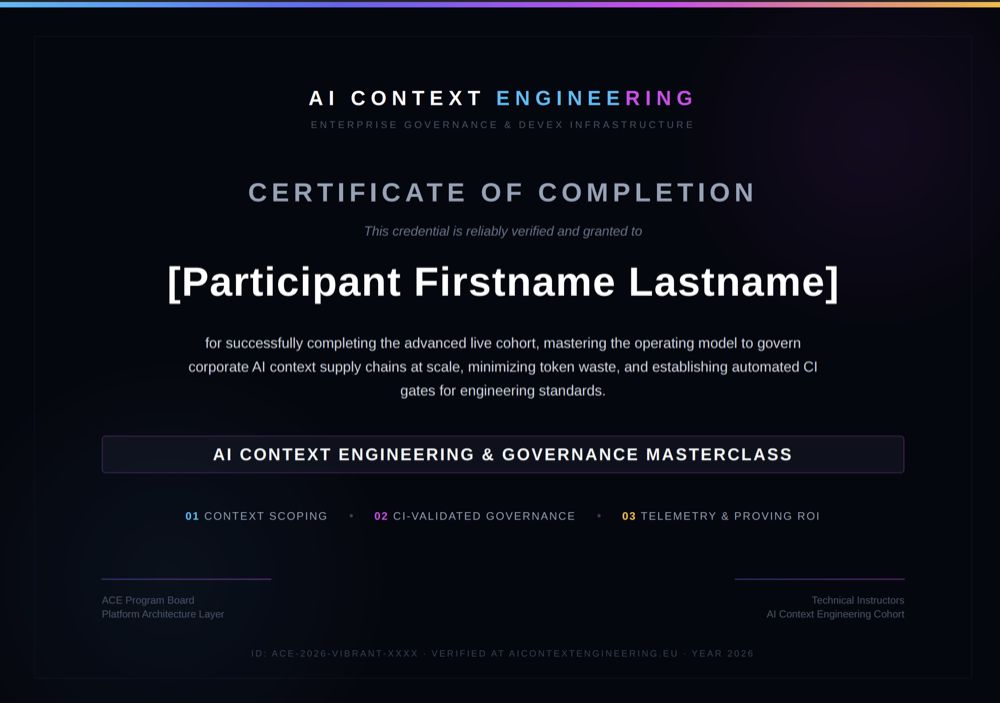
Your ACE Certified Context Engineer certificate - issued on completion. Tap to view full size.
What that gives you
"Finite budget" isn't just ours - it's how Anthropic frames context engineering. Effective context engineering, 2025.
How it works
A context supply chain with two properties engineers feel on day one - plus the governance your security team will ask about.
01 · domain-aware
The system detects the domains in front of the engineer - frontend, backend, platform, security - and delivers only the standards that apply. No thousand-line prompt file.
Smaller, sharper context means fewer tokens burned and cleaner output - every session, every engineer.
Why smaller wins: models attend unevenly to long inputs, losing signal in the middle. Lost in the Middle (2023).
02 · self-updating
Standards are written once, centrally, reviewed like code, and shipped as versioned releases. Every machine stays in sync - approved changes reach the agent before the next session.
No packages to publish, no dependency bumps, no update anyone has to remember. Onboarding is one script. Versioned for the platform team, versionless for engineers.
What that looks like in a monorepo
$ cursor "add rate limit to /login and its form"
[context] detected domains: frontend, backend
[context] checking for changes…
backend/api-security changed → regenerate
frontend/forms changed → regenerate
backend/logging unchanged → skip
frontend/design-sys unchanged → skip
✓ 2 skills refreshed · 6 unchanged, skipped
✓ agent ready on current standards
Touch two domains, get exactly two domains' worth of current standards.
Agenda
No slideware marathon - but the theory isn't filler:2h 40m of durable principles you keep for good, and3h 55m of hands-on labs where you do it yourself. Here's what you leave with:
■ theory 2h 40m·■ hands-on labs 3h 55m
25′ theory · 10′ lab
Map real agent failures to the LLM principle each violates, and decide skill-vs-gate before you've seen the tooling.
25′ theory · 20′ lab
Trace how one standard moves from ownership to approved agent guidance.
20′ theory · 40′ lab
Add a new domain of standards and work through the governance checks that keep it safe.
15′ theory · 30′ lab
Break sample guidance in controlled ways and see which validation layer catches it.
20′ theory · 40′ lab
Tune routing language so the right guidance appears for the right work and stays quiet otherwise.
20′ theory · 40′ lab
Move a context change through rollout and practice the recovery motion.
20′ theory · 25′ lab
Sort ten real engineering rules into "skills guide" vs. "CI enforces" - and defend your calls.
15′ theory · 30′ lab
Simulate a pilot week and decide whether evidence justifies wider rollout.
AI Context Engineering, without the hype
One email a week: practical architecture, research, and engineering signal - plus workshop updates.
One email a week, unsubscribe anytime. By subscribing you agree to our Privacy Policy.
Who it is for
Platform, DevEx, and staff engineering own the standards. But the system scales down just as cleanly - pick your entry point:
path 01 · on-ramp
A real shift, not hype: vendors now call context engineering the successor to prompt engineering. Anthropic, 2025.
Public seats are closed - get notified about the next cohort →
path 02 · the primary path
Fits: a Private Company Workshop → your co-owners, one room
path 03 · go company-wide
Knowing how agents use context is becoming core engineering fluency. A private workshop trains your owners and builders together, tuned to your stack.
Book a 30-minute pilot planning call. We'll map your agent sprawl, choose a repo set, define boundaries, and decide the right format.
Best before procurement, security review, or broader rollout approval.
Recommendations
AI-assisted engineering is becoming the standard way of building software, and one of the most important things is how well you manage context. I have known both Daniel and Jaroslaw for quite some time now, and can attest to their expertise and professionalism. I've also taken a close look at the course material, and I really like how practical it is. If you're looking to optimize the way you are doing AI-assisted engineering, this is the course for you!

CTO · Founder of the Engineering Leadership newsletter (190k+ subscribers)
I spend my time on conference stages and inside other people's codebases, and it's always the same failure modes: prompts cargo-culted between repos, skills that quietly slow every agent down, a bad rule shipped org-wide with no way back, and adoption measured by vibes. This is the first thing I've seen that names those anti-patterns and builds the pipeline that closes them - the operating model I keep wishing my clients already had.

Senior Software Consultant · Conference Speaker
We've all accumulated random AI docs and CLAUDE.md files over time. Having a structured approach to managing that knowledge made a real difference as teams scaled their AI usage.
Lead Software Engineer · Synergy Codes
It is incredibly frustrating when you know exactly what you want from an AI, but without the right context, it just falls back on broad assumptions - giving you irrelevant answers and wasting tokens in the process. We are all trying to figure out how to integrate these tools into our workflows, which is why taking the time for dedicated workshops is an absolute necessity today. Learning exactly how to build and optimize context is what shifts us from merely testing AI to actually steering our agents with precision and efficiency.

Chief Architect · SoftServe
Instructors
 2× Microsoft MVP
Principal Consultant & Tech Lead
 Google Developer Expert
Lead Technical Architect
Enterprise experience
29+
years combined
46
client engagements
20+
talks at international conferences & meetups
Selected cooperations



A selection from 46 engagements - many under NDA.
International conference speakers
Speaking at conferences across Europe and beyond on AI engineering, Angular, and platform architecture.
Need more than a workshop? Plan the pilot with us.
On-site audit, a customized adoption approach, and hands-on support for first rollout.
Pricing
All prices excl. VAT. Scope and final price are set on the planning call.
Tuned to your org and security constraints, with a 2-week implementation pilot included. Sized to your company - scoped on the call.
Best when you want the system mapped to your stack and your whole organization fluent.
From €15,000
Prices excl. VAT · invoicing, PO, and vendor onboarding supported
Enrollment for the first cohort is closed. Individual seats and the team bundle are no longer sold. The second cohort will be announced separately - join the list and you'll hear first.
1-day live workshop · Online · scheduled with your team
Get the next cohort first
We'll email you when dates and pricing for the second cohort are announced.
We'll only email you about the next cohort, unsubscribe anytime. See our Privacy Policy.
Need it sooner, or for a team? A private workshop → runs on your schedule.
Supported by
Partners backing our work and community


FAQ
Three things in one engagement: the complete context supply chain kit (a git repo of scripts, CI checks, and staged releases - full source, not slides), the live one-day workshop where your people operate it on a worked example, and the architecture behind it so your team can adapt it to your own standards afterwards. The kit isn't sold separately - the workshop is the only way to get it. Full breakdown in the “The Assets & The Know-How” section above.
No. Courses teach individual habits; this installs the governed pipeline around your company standards - ownership, CI validation, staged rollout, freshness, rollback, and measurement. You still learn hands-on, but you leave with the working kit, not just tips.
It is a 1-day live workshop, online. Private company workshops are scheduled with you on the planning call - usually a few weeks out. The first public cohort (September 8, 2026) is closed to new enrollments.
Not right now. Individual seats and the team bundle are no longer sold. The second cohort will be announced separately - join the list and you'll hear first. What is bookable today is the Private Company Workshop: delivered for your organization, tuned to your stack, with a 2-week implementation pilot included.
It will be announced separately, with its own dates and pricing - we are not taking seat sales for it yet. Add your email in the pricing section (or subscribe to the newsletter) and you will hear about it before it goes public.
It is live and hands-on - you operate the kit yourself in guided labs, on a worked example. All templates, lab material, and the kit you take home are yours to keep. Sessions are not recorded unless we confirm otherwise in writing before the workshop begins, and participants may not record, stream, capture, or transcribe the session (including screenshots and AI note-taking bots) without prior written consent. The lasting value is the kit and materials you keep, not a video.
Full refund up to 14 days before the workshop date. Inside that final 14-day window it switches to rescheduling - we move your private workshop to the next date that works for your team. Individual participants can always be swapped for colleagues at no cost.
You can - and most teams start there. The problem isn't writing the rules, it's everything after: copies drift apart across repos and tools, nothing validates changes before agents consume them, there's no staged rollout or rollback, and nobody can measure whether agents actually follow the rules. The workshop gives you the operating model around the files - versioning, validation, distribution, telemetry - in one day instead of months of trial and error.
Foundations workshops teach engineers how to use agents better: prompting, context windows, hallucination prevention, MCP, and local project setup. This workshop starts one layer higher. It teaches platform and engineering leaders how to run a context supply chain as company infrastructure: owned, validated, released, rolled back, and measured across teams, repos, and tools. If your team is still learning the basics, foundations training is useful. If you already have agents in use and need consistency, governance, and proof, this is the operating model.
It absolutely can - we've watched a senior developer install a stack of skills, watch every prompt get slower and more expensive, delete them all, and go fast again. That's the trap - and it isn't only about cost: attention is finite even when the window isn't, so the more you pile in, the more the rule that actually matters for the task at hand gets buried and ignored. This system is built around scoped guidance instead: shared rules stay small, domain guidance is routed by the work at hand, only the skills that changed get regenerated, and the pilot tracks whether the right guidance is actually activating. You stop guessing which rules help.
Two layers, and neither is a black box. Scoping - which domains of standards apply in a repo - is deterministic and signal-based: the same repo resolves the same way every time, with an explicit override for monorepos. No embedding lottery, no per-run drift. Which specific rule then activates for a given prompt is the agent's own call from each rule's description - the probabilistic layer - which is exactly why we measure activation and eval it rather than assume it.
Three layers, and we're honest about each. Structure is gated automatically before anything ships, so a change that would break the corpus fails fast. Behaviour is checked with agent evals - multiple trials, rubric-graded - for the rules that justify the cost, run on a schedule rather than as a blunt per-commit gate (agent evals are slow and non-deterministic). And in a pilot, redacted telemetry shows the trend on real work. We don't pretend CI proves quality: CI proves the change is valid, evals catch regressions, telemetry shows the trend.
Real, and newly formalized. A July 2025 academic survey (Mei et al.) synthesized over 1,400 papers into a defined discipline: context as a finite, structured resource you assemble and optimize, not a static prompt. What the literature has barely touched is the operational layer - governing, versioning, and distributing that context across a whole team - which is exactly what this workshop and kit build. Reference: arxiv.org/abs/2507.13334.
Different axis. MCP gives agents capabilities: tools and live resources at runtime. This system governs standards: the company guidance agents should follow across repos and tools. Most mature teams eventually need both. MCP is a capabilities layer; this is the standards-governance layer.
Control stays with the platform team. Changes move through reviewed releases and staged channels, while engineers avoid per-repo update work. The workshop teaches the rollout and rollback motions so the system is governed centrally without becoming busywork for every developer.
Almost nothing. Once, they run a single setup script - or you push it to their machines through your existing MDM / managed-device tooling, so it's already there and they do nothing at all. After that it's invisible: the right standards load into their agent automatically, refreshed before each session. There's no system for them to learn, no versions to bump, no per-repo files to maintain. The platform team owns the pipeline; everyone else just codes.
It is designed to avoid modifying application repositories. The install path is user-level, controlled by your organization, and can be disabled if your rollout policy requires it. The workshop covers the operational boundaries so platform and security reviewers know exactly what is in scope.
Every participant gets a 30-day follow-up q&a call with the instructors and access to the private alumni channel, on top of the templates and the kit you take home. The private workshop additionally includes a rollout roadmap and a 2-week implementation pilot for your organization; we can also set the kit up on your standards as a paid add-on.
Yes. The Private Company Workshop includes a 2-week implementation pilot: we help your owners select a small repo set, define baseline metrics, install the pilot channel, review activation telemetry, and turn the result into a leadership-ready rollout recommendation. The point is not to promise generic ROI; it is to prove whether the system works in your environment.
Comfort with git, a terminal, and JSON, plus a recent Node.js (v20+) installed - every lab tool is a single dependency-free script, so there is nothing else to set up. No specific coding agent or IDE is required.
No. Smaller teams can still get the core value: standards written once, current across their agent setup, and easier to review. Larger organizations use more of the governance, rollout, and measurement layers as they scale.
The Private Company Workshop is the format: from €15,000 (launch price), sized to your company and scoped on a 30-minute planning call - tailored to your platform and including a context architecture review, a rollout roadmap, and a 2-week implementation pilot to prove the rollout in your repos. It works from a handful of platform owners up to a company-wide rollout. We also take direct consulting engagements: an on-site audit of your AI coding setup, a customized adoption approach, and team training.
Private workshops are invoiced: we send a quote after the planning call, then a VAT invoice with your company details and VAT ID. Bank transfer, purchase orders, and vendor onboarding are supported, and card payment is available on request. All listed prices are excl. VAT; EU businesses with a valid VAT ID are reverse-charged (0% invoiced, you self-account).
Not at the moment: we only sell the private company workshop, and individual seats are closed until the second cohort is announced. Put your email in the pricing section and you'll be told when seats open again. If you're employed, the other route is your employer booking a private workshop - the manager brief is written to be forwarded for exactly that conversation.
Private workshops
Enrollment for the first cohort is closed, so the private workshop is the way in - tuned to your stack, scoped on a 30-minute planning call, with a 2-week implementation pilot included.
1-day live workshop · Online · scheduled with your team · 30-day follow-up Q&A call with the instructors
Not a company decision yet? Grab the full outline above, or send the manager brief to your decision maker. Waiting on the second cohort? Get notified when it's announced.